Should You Round Your PD Up or Down?
4 MIN READ
By Pupillary Distance Team ·
Written by the team that builds the app, not by clinicians — how we research and source these guides.
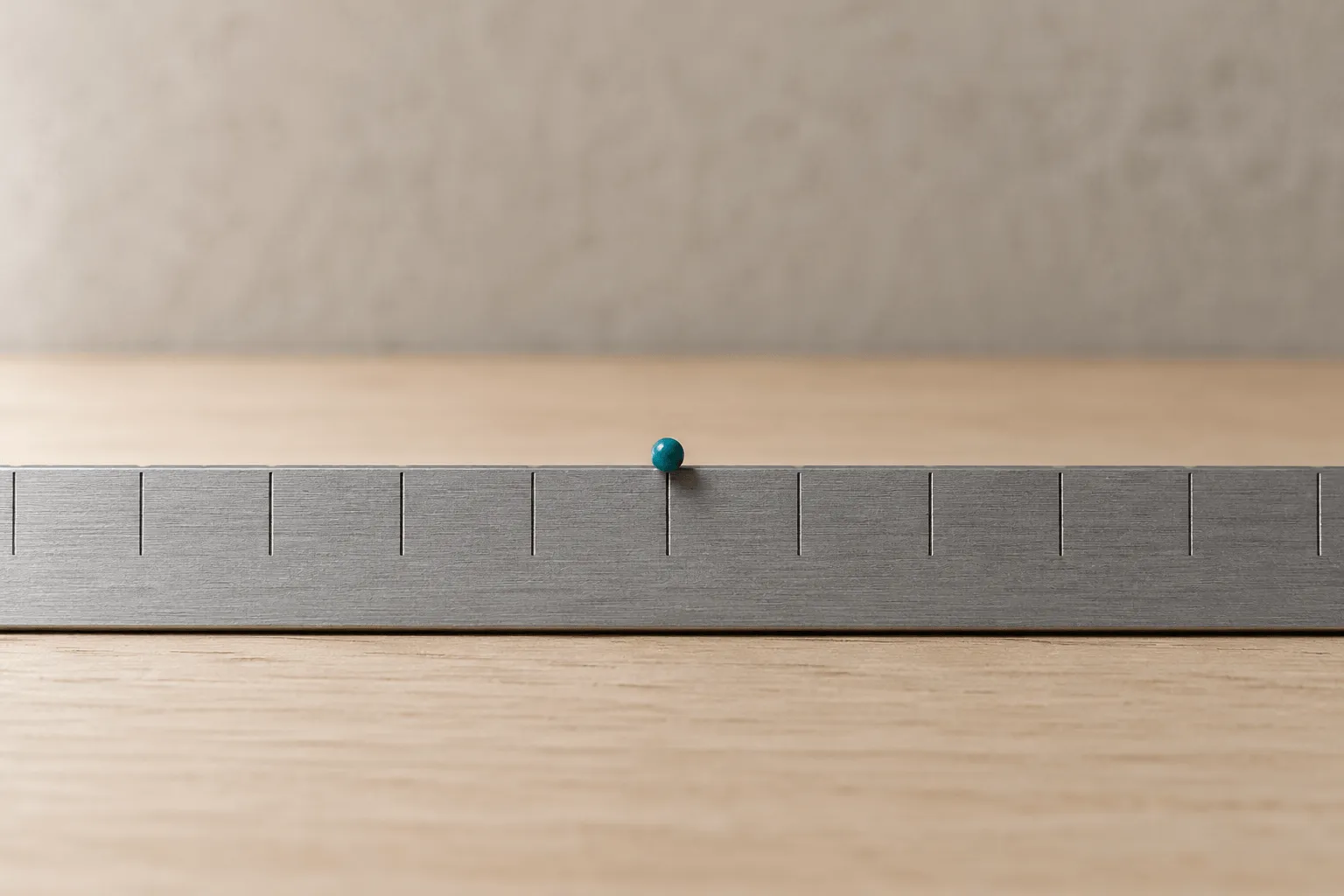
Should you round your PD up or down?
Either, for most prescriptions. There is no convention that says round up, and no standard that says round down.
That answer is unsatisfying without the reason behind it, so here is the reason: rounding by half a millimeter moves each lens’s optical center by half a millimeter, and how much that costs depends entirely on how strong the lens is. At ordinary powers it is smaller than the manufacturing tolerance. At high powers it is not. The rest of this page works out where the line sits.
If the form accepts a decimal — most do — the simplest answer is to skip the question and enter what you measured.
What does half a millimeter actually change?
It induces a small prism, and the amount follows Prentice’s rule: prism in diopters equals the decentration in centimeters multiplied by the lens power in diopters. Half a millimeter is 0.05 cm.
| Lens power | Prism from 0.5 mm of rounding |
|---|---|
| −1.00 D | 0.05 prism diopters |
| −2.00 D | 0.10 |
| −4.00 D | 0.20 |
| −6.00 D | 0.30 |
| −8.00 D | 0.40 |
(Computed from Prentice’s rule; the same arithmetic applies to plus lenses.)
Now the reference point. The 2024 comparison of PD measurement techniques judged its results against a tolerance of 0.33 prism diopters for horizontally induced prism, from ISO 16034.
Put those together and the line is sharp: half a millimeter of rounding stays inside that tolerance up to about 6.6 diopters. Below that, the rounding direction is not a decision worth agonizing over. Above it, the same half millimeter starts to exceed the tolerance a lens would be manufactured to, and you should not be rounding at all.
The rounding question is smaller than the measurement question
Here is the part that reframes the whole thing. While you are deciding between 63 and 64, the measurement you are rounding is probably not accurate to a millimeter in the first place.
In one study of self-measurement, people measuring their own PD in a mirror repeated to only about 4 mm either way, and individual readings differed from a clinical pupillometer by as much as 5 to 6 mm in either direction. A trained examiner with a PD rule repeated to within about 1 mm.
So the honest ranking of what affects your lenses, largest first:
- How you measured — several millimeters of potential error
- Which PD you used — far versus near differ by about 3 mm
- Whether you rounded — half a millimeter
Optimizing the third while ignoring the first two is the wrong order. If a half millimeter genuinely matters for your prescription, that is a signal to take the measurement more carefully, not to think harder about rounding. Our guide to measuring PD at home covers what each method is actually worth.
When does rounding actually matter?
Three cases, and they overlap:
Strong prescriptions. Past roughly 6 diopters, as the table shows, half a millimeter is no longer negligible. Enter the decimal, or have an optician measure it.
Progressive lenses. Their distance, intermediate and reading zones sit in a narrow corridor, so each lens has to be centered on the eye looking through it. Progressives also want per-eye monocular values, which are conventionally written to the half millimeter — rounding those away discards the precision they exist to carry.
Monocular values generally. A binocular PD of 63 rounded from 63.5 moves each lens by a quarter of a millimeter, since the error splits across two eyes. A monocular value of 31.5 rounded to 32 moves that one lens by the full half millimeter. The same rounding is twice as consequential on a per-eye number.
What if the form won’t take a decimal?
Some checkouts only accept whole numbers. Three options, in order:
- Look for the dual-PD field. Many retailers accept two per-eye numbers even when the single-PD box is integer-only, and those fields usually take decimals.
- Round, and note which way. For a low-power single-vision order, pick either. If you later order a stronger pair, you will want the real number, so write it down somewhere rather than relying on what you typed.
- Take a third measurement. If you are stuck between two values because two readings disagreed, a third reading and an average is a better tiebreaker than a rounding rule — and it addresses the error that actually matters.
If you want to check a value against the published adult distribution, or convert between far, near and per-eye numbers, the PD calculator does both.
And the usual boundary: this is about a measurement, not about your eyes. If correctly made glasses still feel wrong, that is a conversation for an optometrist or ophthalmologist rather than another round of arithmetic.
Frequently asked questions
Keep reading
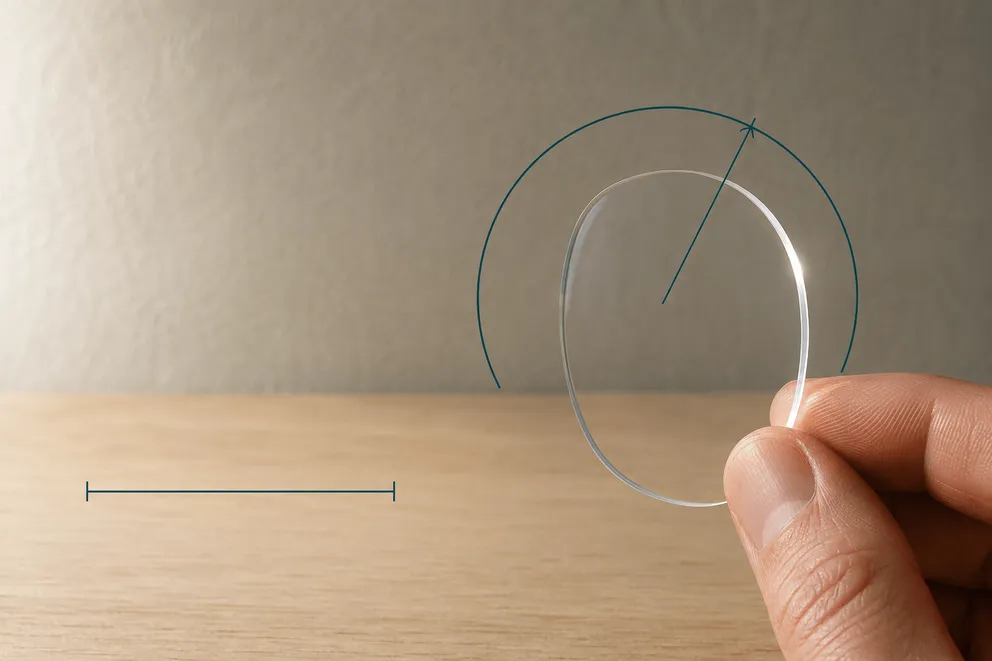
Is Pupillary Distance the Same as Axis?
Is pupillary distance the same as axis? No — PD is in millimeters, axis in degrees. Why the two get confused on a prescription, and what a mix-up does.
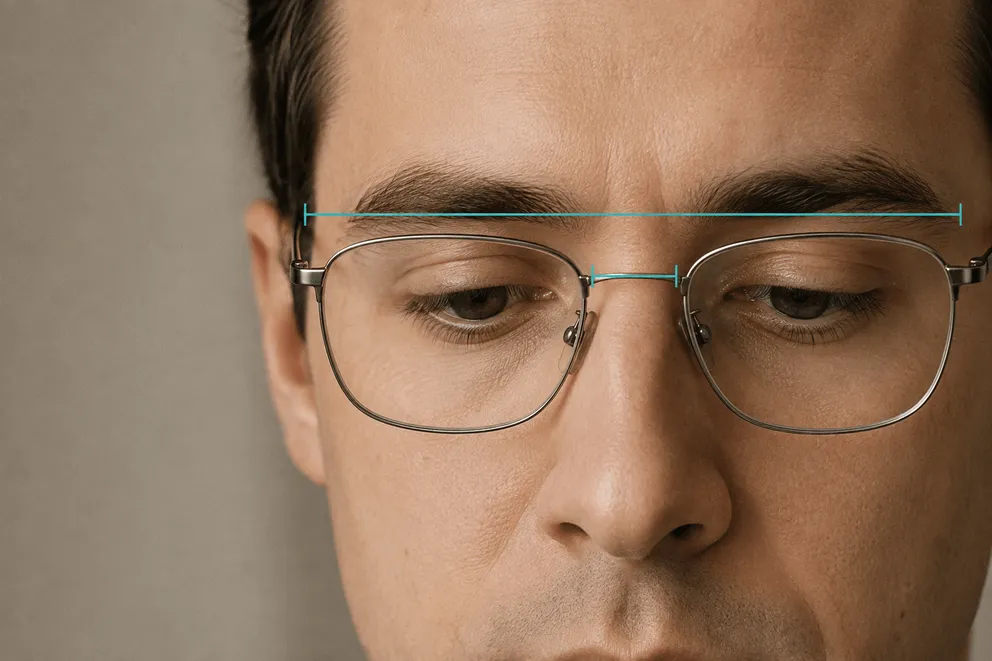
How to Measure Your Face for Glasses (Frame Width, Bridge & Lens Size)
Measure your face for glasses: the three numbers on every frame, taking them from an old pair or your face, which one decides the fit, and where PD fits.
4.4★ · 310+ Reviews
Your PD, measured in under a minute.
Pupillary Distance turns your iPhone into an accurate PD meter. Measure once, then order glasses online with confidence.