How to Measure Pupillary Distance for Glasses at Home (3 Methods)
10 MIN READ
By Pupillary Distance Team · · Updated
Written by the team that builds the app, not by clinicians — how we research and source these guides.
Our pick: Pupillary Distance for iPhone. It measures your PD in 3D with the TrueDepth front camera — no ruler to keep level, no eye to close, no friend to recruit — and gives you far PD, near PD and both monocular PDs in one pass, privately on your iPhone and ad-free. Download it on the App Store.
What is pupil distance, and why do you need it for glasses?
Pupillary distance — also written pupil distance, or just PD — is one number: the gap, in millimeters, between the centers of your two pupils. Opticians use it to position the optical center of each lens exactly where your eye looks through it. Most adults measure between 50 and 75 mm, averaging about 63 mm — roughly 62 mm for women and 65 mm for men.
Get it wrong and each lens sits off-center, turning it into a prism whose strength follows Prentice’s rule: the displacement in centimeters times the lens power in diopters. So 3.5 mm off on a strong lens — say −4.00 D — works out to about 1.4 prism diopters, while a weak prescription off by the same amount induces almost nothing. In one study of 120 single-vision wearers, mean decentration was about 3.5 mm and the induced prism ran from −0.7 to +0.6 prism diopters; 57% weren’t looking through the optical center, and 40% of those reported eye ache, fatigue, or headaches. What a PD error costs you therefore depends on your prescription as much as on the error: as an ophthalmologist answering for the American Academy of Ophthalmology’s EyeSmart service puts it, progressive lenses in a high plus or minus power can be problematic if the PD is off by a small amount, while low-power single-vision glasses may cause no symptoms even when the PD is off significantly.
In a store, the optician measures your PD as part of the fitting. Online — where you’re buying without an optician in the room — the retailer asks you for it, and your prescription probably doesn’t carry it: the FTC notes that only a few states require prescribers to write PD on the prescription, though you may be able to request it under HIPAA or state medical-records rules if it was measured. Otherwise, you measure it yourself. Here’s how to do that accurately.
How do you measure your pupillary distance with a ruler and a mirror?
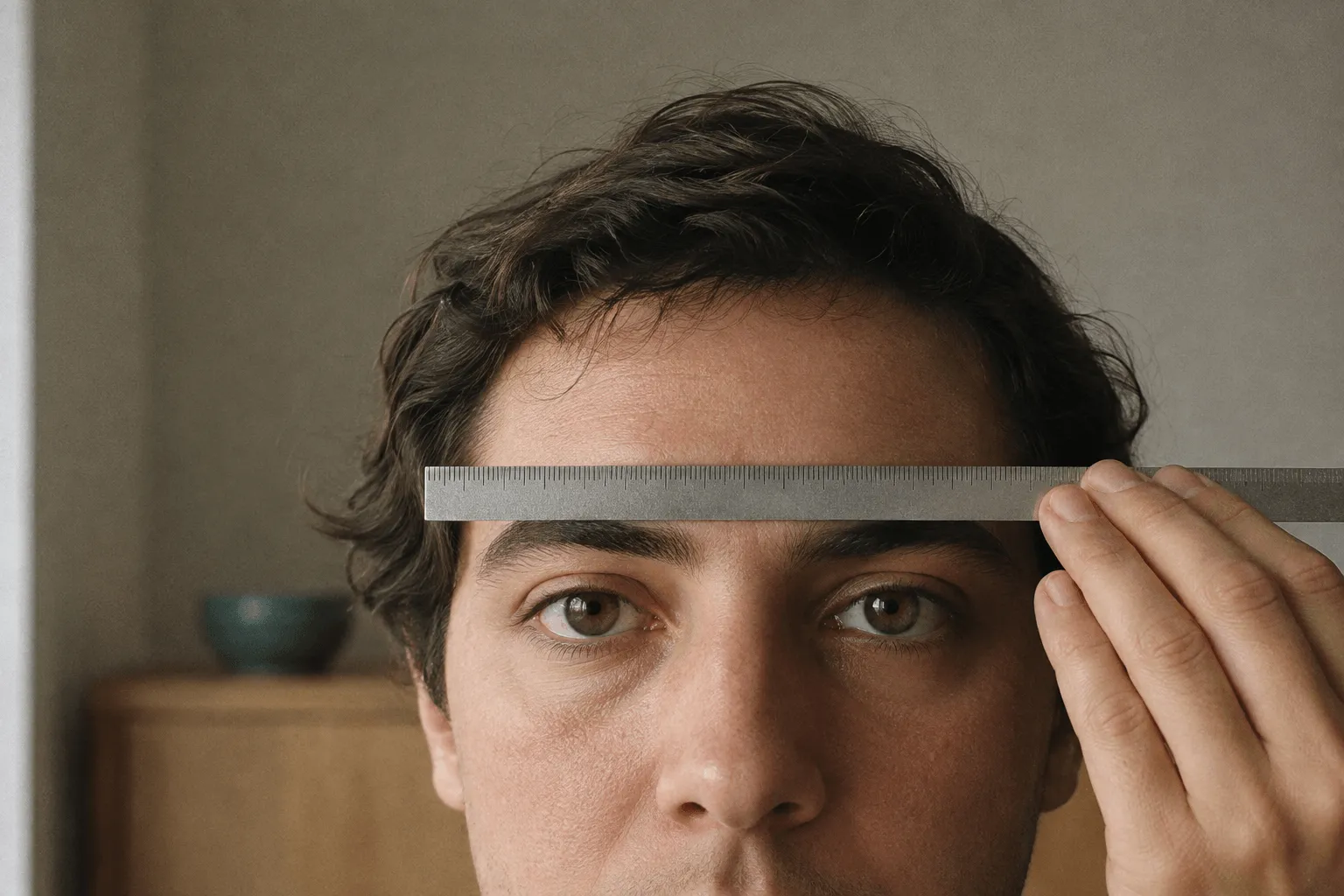
Stand about 20 cm (8 inches) from a mirror, hold a millimeter ruler against your brow, close your right eye and line the 0 up with your left pupil, then close your left eye and read the mark over your right pupil. Treat the result as approximate, and as closer to your near PD than your far PD: your reflection sits about twice the mirror distance away, which is roughly the convergence distance near PD is defined at — so expect it to read a couple of millimeters low.
- Stand about 20 cm (8 inches) away from a mirror.
- Hold the ruler flat against your brow, just above your eyes, with the millimeter side down.
- Close your right eye. Slide the ruler so the 0 lines up with the center of your left pupil.
- Hold the ruler perfectly still, then close your left eye and open your right.
- Read the millimeter mark that sits over the center of your right pupil.
Look straight ahead the whole time and keep the ruler level — tilting it or glancing sideways shifts the perceived center of your pupils and pushes the number too wide. Measure three times and average, and expect some spread while you do: in a study of self-measurement accuracy, mirror self-measurements averaged within about half a millimeter of the clinical pupillometer, but individual readings differed from it by as much as 5 to 6 mm in either direction, and people repeated to only about ±4 mm where a trained examiner with a PD rule repeated to within about ±1 mm. A few millimeters of spread is normal here, which is why you average; if two readings differ by more than about 5 mm, check the ruler is level and your gaze straight ahead, and take a third.
How do you measure PD with a friend?
Sit down, look at something as far away as you can — across the room, or out of a window — so your eyes relax into their distance position, and have a friend hold a millimeter ruler across the bridge of your nose and read from the center of one pupil to the center of the other. That gives you your far PD.
- Look at something far away — out a window, or right across the room.
- Have your friend rest the millimeter ruler across the bridge of your nose, on your cheeks.
- Keeping your gaze fixed on the distant object, they read pupil center to pupil center.
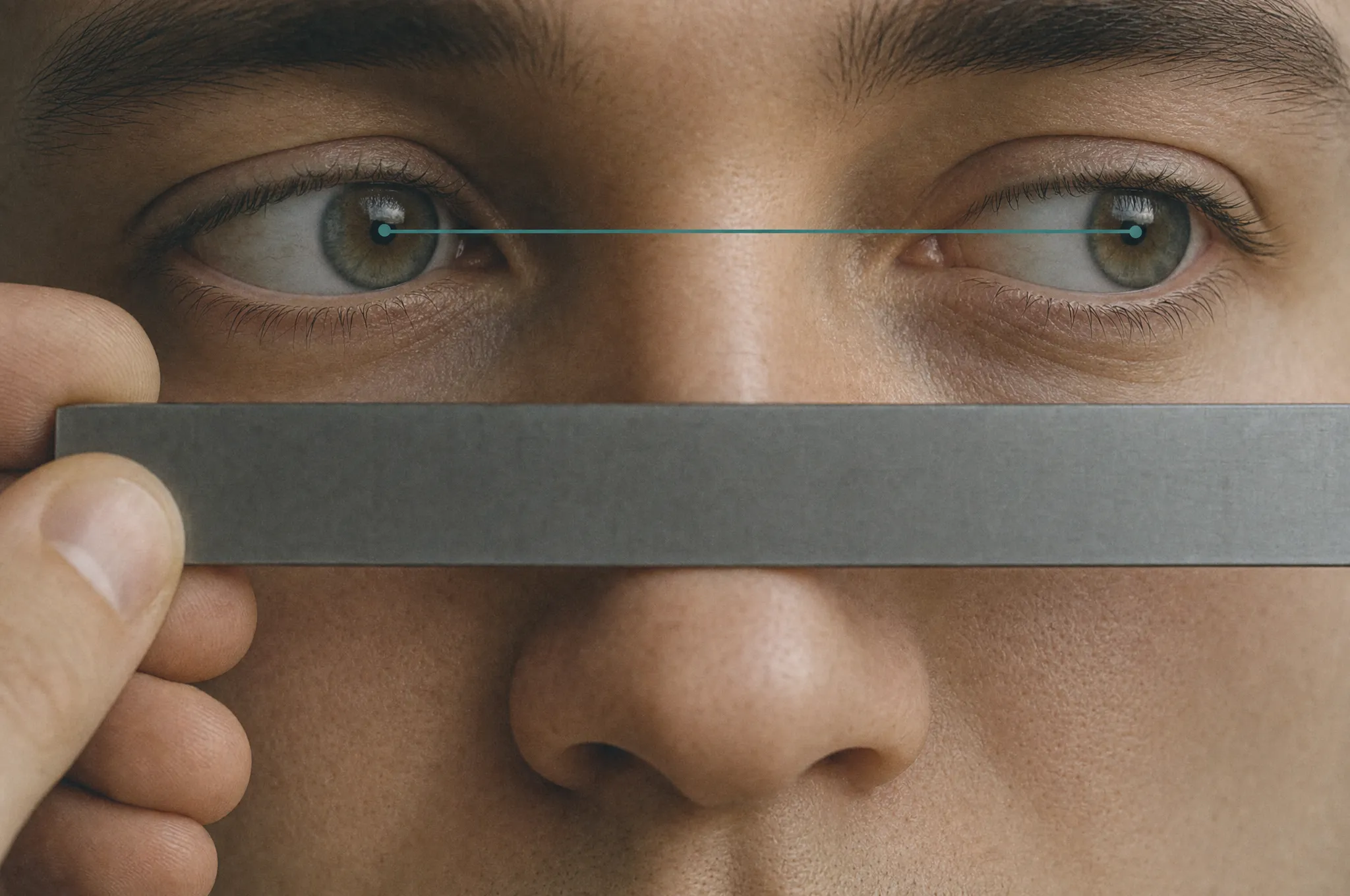
A second person removes the awkward one-eye-at-a-time dance and gives a steadier reading — steadier, though, isn’t the same as more accurate. In that same study, an untrained friend differed from a clinical pupillometer by about 2 mm on average — four times the mirror’s gap. It’s a trained examiner with a PD rule who is the dependable one — not because the average gap is smaller (about 0.6 mm, versus about 0.5 mm for self-measurement in a mirror) but because the spread is: the examiner’s readings stayed within about 2 mm of the pupillometer, while individual self-measurements differed from it by as much as 5 to 6 mm in either direction.
Can you measure your PD with your iPhone instead of a ruler?
Yes. An iPhone’s TrueDepth front camera builds a real-time 3D model of your face — its position, orientation, and topology — and measures the straight-line distance between your pupils from that model. No ruler to keep level, no eye to close, no friend to recruit, and the parallax that widens ruler readings doesn’t apply.
Parallax is what both ruler methods are fighting. The moment your line of sight isn’t perpendicular to the ruler, the perceived center of the pupil shifts and the reading widens — a 2024 comparison of PD measuring techniques names exactly that as the reason ruler readings over-estimate. It’s why two careful people often get two different numbers.
That same comparison found a smartphone front-camera PD app — Eye Measure, on 40 participants — differed from a clinical pupillometer by an average of 0.6 mm (95% limits of agreement −2.9 to +1.7 mm), close enough that the authors judged it inside spectacle-manufacturing tolerance — as, in that study, were the ruler methods. The paper describes the tested app only as using the front-facing camera to scan the face; it is not ours, and no published study has independently validated ours. We make the Pupillary Distance app and recommend it because it measures from the 3D face model an iPhone’s TrueDepth front camera builds and reports far PD, near PD, and both monocular PDs in one pass — near PD is where hand measurement struggles most, over-reading about twice as much as it does at distance. If you’d rather not download anything first, here’s how measuring your PD online with your phone camera works step by step.
| Method | What you need | Typical error vs. a clinical pupillometer | Gives monocular PD? |
|---|---|---|---|
| iPhone front camera | An iPhone with a TrueDepth front camera | About 0.6 mm on average, limits −2.9 to +1.7 mm; no millimeter repeatability published for a phone app of this kind (the 2024 study reports only a test-retest correlation), though an older study of a pre-depth-camera iPod app found it both the least accurate and the least repeatable (roughly ±6.5 mm) of the consumer methods it tested | Yes, in the same pass |
| Ruler and mirror, on your own | Millimeter ruler, mirror | About 0.5 mm on average, but individual readings differed from it by as much as 5 to 6 mm in either direction; repeats to roughly ±4 mm | Not easily |
| Ruler held by a friend | Millimeter ruler, second person | Differs by about 2 mm on average; repeats to roughly ±4 mm | Not easily |
| Optician with a PD rule or pupillometer | A visit | The reference method is the pupillometer; a trained examiner with a PD rule differs from it by about 0.6 mm on average and repeats to within about ±1 mm | Yes |
Mirror, friend, and optician rows: McMahon et al. 2012, 52 participants. iPhone row: the 2024 comparison, 40 participants — a different sample and protocol, so read across the rows with that in mind.
No ruler, no parallax, and the monocular values in the same pass: measure your PD with Pupillary Distance.
What is the difference between far PD and near PD?
Far (distance) PD is measured with your eyes relaxed on a distant target, and it’s the number for everyday and distance glasses. Near PD is measured with your eyes converged on something close, about 40 cm away; because your eyes turn slightly inward to focus, it comes out about 3 mm smaller. Progressive lenses use both.
| PD type | What it is | How it’s measured | Typical adult value | Which glasses need it |
|---|---|---|---|---|
| Far (distance) PD | Pupil center to pupil center, eyes relaxed | Gaze fixed on something at least 6 m away | About 63 mm on average; most adults 50–75 mm | Everyday and distance single-vision, plus progressives |
| Near PD | The same distance with your eyes converged for close work | Gaze fixed on something about 40 cm away | About 3 mm less than your own far PD | Reading glasses, plus progressives |
| Monocular PD | Nose bridge center to each pupil, recorded separately | One eye at a time, from a fixed point on the bridge | Roughly half your far PD per side, and often not equal | Progressives and strong prescriptions |
If you only have one number and you’re ordering single-vision distance glasses, use your far PD.
Do you need monocular PD, or is a single PD enough?
A single (binocular) PD is fine for most single-vision glasses. Monocular PD — the distance from the center of your nose bridge to each pupil, measured separately — matters for progressive lenses and strong prescriptions, because most people’s faces are asymmetrical and the two sides are often not the same distance from the bridge.
Clinics record both, precisely because that asymmetry can put a lens’s optical center in the wrong place. Measuring it with a ruler is fiddly — there’s no pupil to line the 0 up with, only a point on the bridge of your nose — while a depth-camera measurement handles it automatically.
What are the most common PD measuring mistakes?
Four mistakes are worth guarding against: letting your gaze drift off-axis, so parallax widens the reading; measuring against a close target when you want far PD; taking one reading instead of averaging several; and using a worn or inch-only ruler. The first two are the ones the literature singles out.
- Parallax / looking sideways. Keep your gaze straight ahead and the ruler level. Off-perpendicular sightlines shift the perceived center of the pupils, and the reading comes out too wide.
- Measuring against a close target when you want far PD. Converging on something close gives you a near PD, which runs about 3 mm below far PD — and by ruler, near readings miss by about twice as much as distance readings. For a far PD, fix your eyes on something genuinely distant, or use a method that measures both.
- One reading. Always measure two or three times and average them.
- A worn or inch-only ruler. Use a clean millimeter scale; converting inches introduces rounding error.
Which PD number do you actually need for glasses?
For most people ordering single-vision glasses online: one far PD, usually somewhere between 50 and 75 mm. For reading glasses, your near PD, about 3 mm less. For progressives or a strong prescription, two monocular PDs. A reading outside the usual range is worth repeating, because the ruler is error-prone — not because your face is out of spec.
Whichever you need, measure it carefully — or let Pupillary Distance measure all of them at once on your iPhone and skip the guesswork.
Frequently asked questions
Keep reading
Is Pupillary Distance the Same as Axis?
Is pupillary distance the same as axis? No — PD is in millimeters, axis in degrees. Why the two get confused on a prescription, and what a mix-up does.
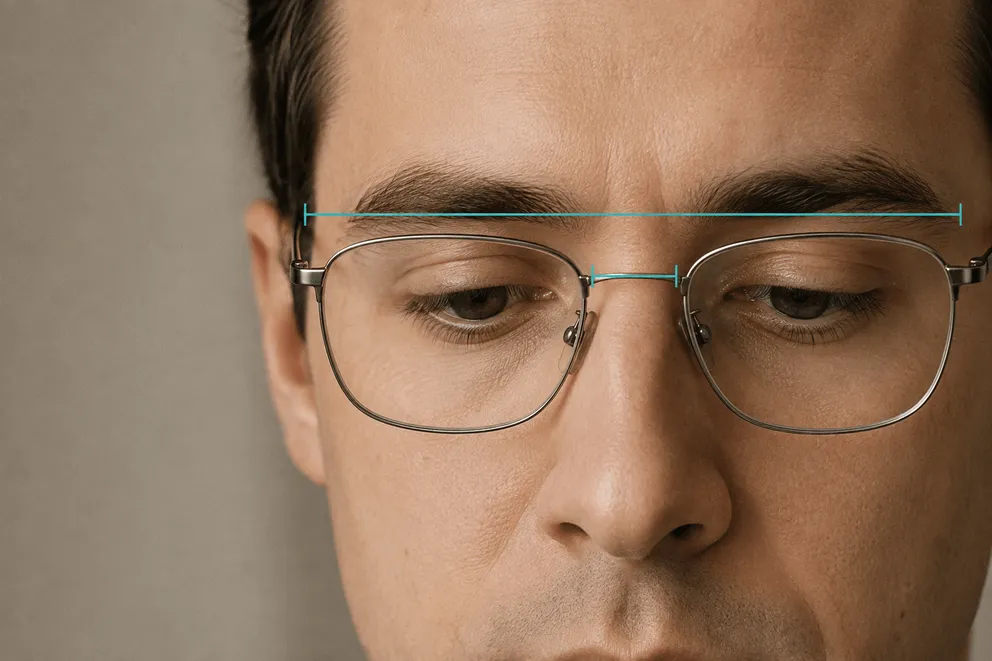
How to Measure Your Face for Glasses (Frame Width, Bridge & Lens Size)
Measure your face for glasses: the three numbers on every frame, taking them from an old pair or your face, which one decides the fit, and where PD fits.
4.4★ · 310+ Reviews
Your PD, measured in under a minute.
Pupillary Distance turns your iPhone into an accurate PD meter. Measure once, then order glasses online with confidence.