Is Pupillary Distance the Same as Axis?
4 MIN READ
By Pupillary Distance Team ·
Written by the team that builds the app, not by clinicians — how we research and source these guides.
Is PD the same as axis?
No. Different units, different subjects, different purposes.
| Pupillary distance | Axis | |
|---|---|---|
| What it measures | Distance between pupil centers | Orientation of the cylinder correction |
| Unit | Millimeters | Degrees, 1 to 180 |
| Describes | Your face | One lens’s correction for astigmatism |
| Typical value | About 50 to 75 for adults | Any value from 1 to 180 |
| Where it comes from | A fitting measurement | The eye examination |
The only thing they have in common is that both are numbers on the same piece of paper, and both are needed to make your glasses correctly.
What is axis?
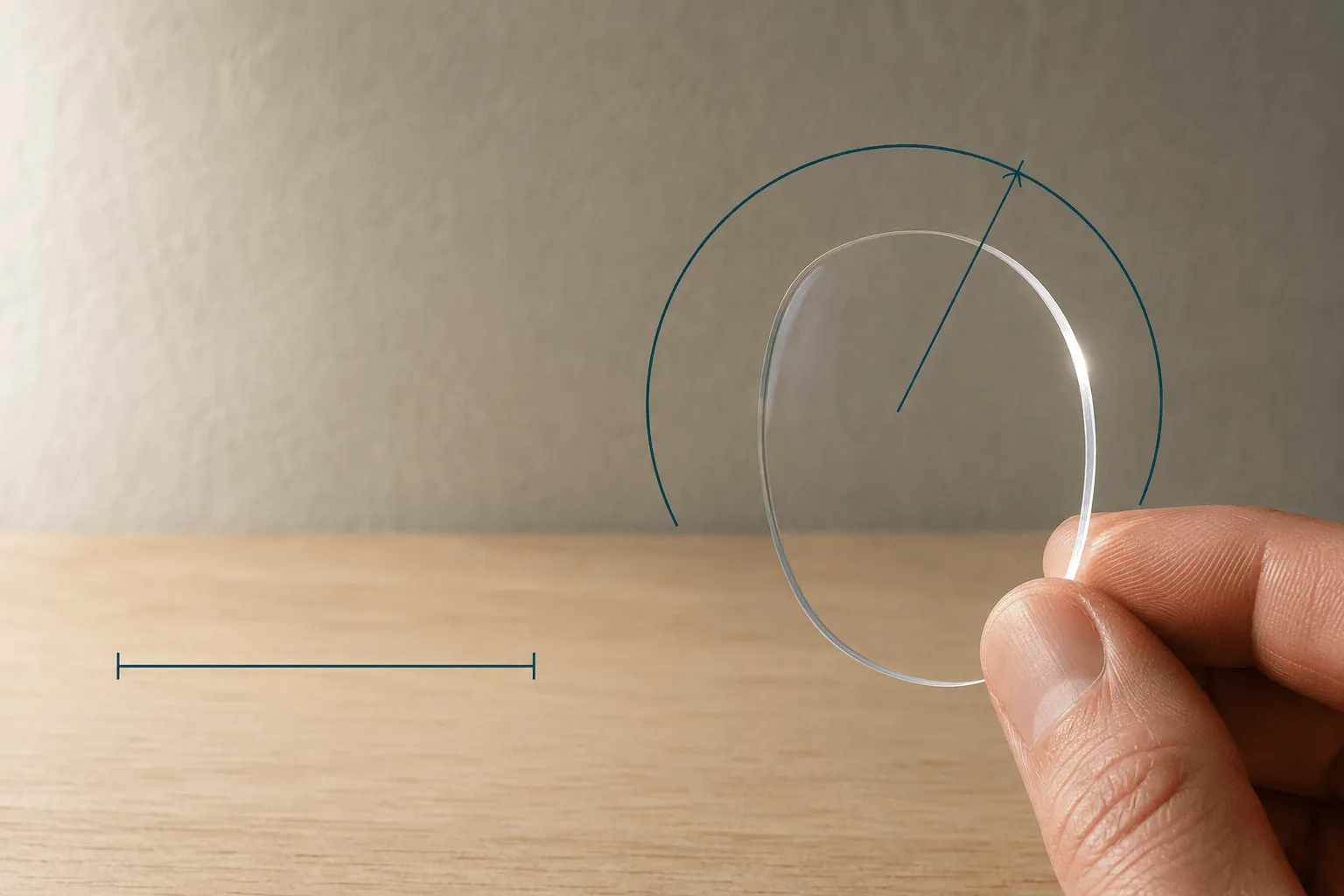
Astigmatism means the eye’s optics are not the same in every direction — the cornea is shaped a little more like a rugby ball than a football. Correcting it needs a lens that is stronger along one meridian than another, and the lens therefore has to be rotated to the right orientation in the frame.
That orientation is the axis: a number from 1 to 180, describing the angle in degrees. It always accompanies a cylinder value in the neighbouring column. An axis on its own means nothing — if there is no cylinder, there is no astigmatism correction to orient, and the field is usually blank or shows a dash.
What is PD, briefly?
Pupillary distance is the distance between the centers of your two pupils, in millimeters. Its job is to tell the lab where to place the optical center of each lens, so that each eye looks through the point the lens was ground for.
It is a measurement of your face rather than of your vision, which is why it does not change when your prescription does — and why it is often missing from a prescription entirely. Our post on what pupillary distance is covers it properly, and where the PD sits on a prescription covers what to do when it isn’t there.
Why do people confuse them?
Because of an unlucky coincidence of ranges.
An adult PD is usually somewhere between 50 and 75. An axis runs from 1 to 180. So a value like 65 is entirely plausible as either. If you are reading an unfamiliar prescription, hunting for the number an online form wants, and you land on the axis column, nothing about the result looks wrong.
That is what makes this a genuine hazard rather than a naming quibble. A checkout will not reject an axis value in a PD field, because it cannot tell. You find out later, wearing glasses that feel subtly wrong for a reason nobody can point at.
Two habits prevent it:
- Read the column heading, not the position. PD is almost never inside the OD/OS grid; axis always is.
- Check the shape of the number. An axis of 180 or 5 is common; a PD of 180 or 5 is impossible. If your “PD” is outside roughly 50–75, you are probably looking at the wrong column.
Does either one have to be exact?
Both benefit from being right, and for both the answer depends on the strength of the correction — which is a more useful framing than a blanket rule.
For PD, an error decenters the lens and induces prism proportional to the lens power. For axis, an error means the cylinder is rotated away from the meridian it was meant to correct. As an ophthalmologist answering for the American Academy of Ophthalmology’s EyeSmart service explains, the degree of symptoms in both cases depends on the strength of the prescription and the size of the error — progressive lenses in a high power can be problematic when the PD is off by a small amount, while low-power single-vision glasses may cause no symptoms even when it is off significantly.
So the practical answer is the same for both numbers: the stronger the correction, the less room there is to be casual.
What if you have already ordered with the wrong number?
If the glasses have not shipped, contact the retailer — a PD correction before manufacture is usually free and quick.
If they have arrived and feel wrong, check the numbers against your prescription before assuming the prescription itself is bad. Compare what you entered with what the sheet says, column by column. If the PD you used came from a home measurement rather than the prescription, remember that home measurement is imprecise: mirror self-measurement repeats to only about 4 mm either way, so a re-measure is worthwhile before concluding anything.
You can check a PD against the published adult distribution, or convert between far, near and per-eye values, with the PD calculator.
And where this stops being a measurement question: if the numbers all check out and the glasses still feel wrong, see an optometrist or ophthalmologist. That is a prescription conversation, not an arithmetic one.
Frequently asked questions
Keep reading
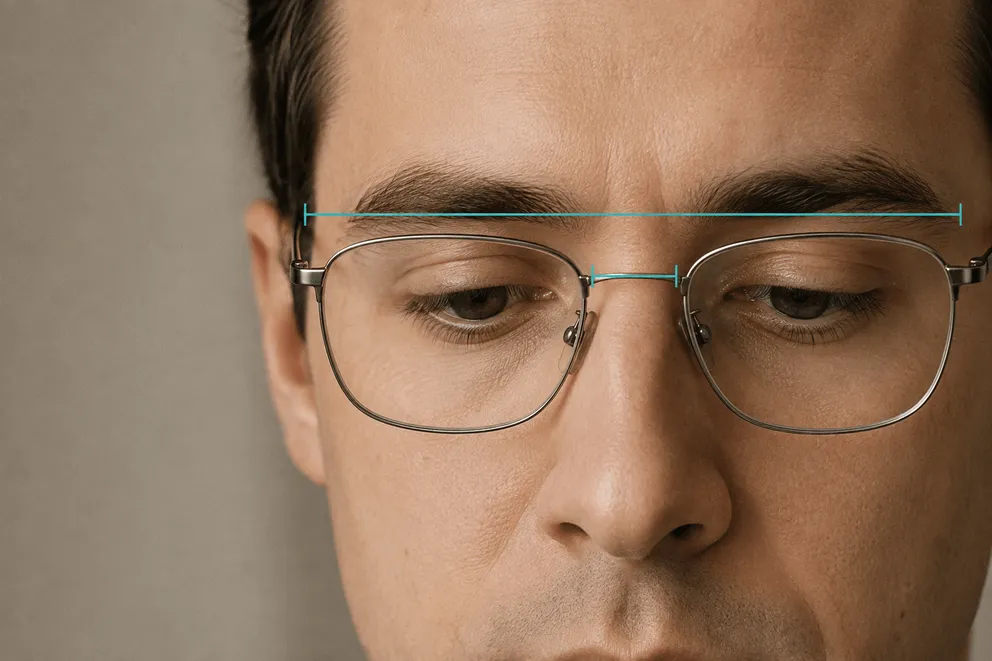
How to Measure Your Face for Glasses (Frame Width, Bridge & Lens Size)
Measure your face for glasses: the three numbers on every frame, taking them from an old pair or your face, which one decides the fit, and where PD fits.
Should You Round Your PD Up or Down?
Should you round your PD up or down? What half a millimeter actually costs, from Prentice's rule, and why how you measured matters far more than rounding.
4.4★ · 310+ Reviews
Your PD, measured in under a minute.
Pupillary Distance turns your iPhone into an accurate PD meter. Measure once, then order glasses online with confidence.