How to Measure Your Face for Glasses (Frame Width, Bridge & Lens Size)
7 MIN READ
By Pupillary Distance Team ·
Written by the team that builds the app, not by clinicians — how we research and source these guides.
What do the numbers on your glasses mean?
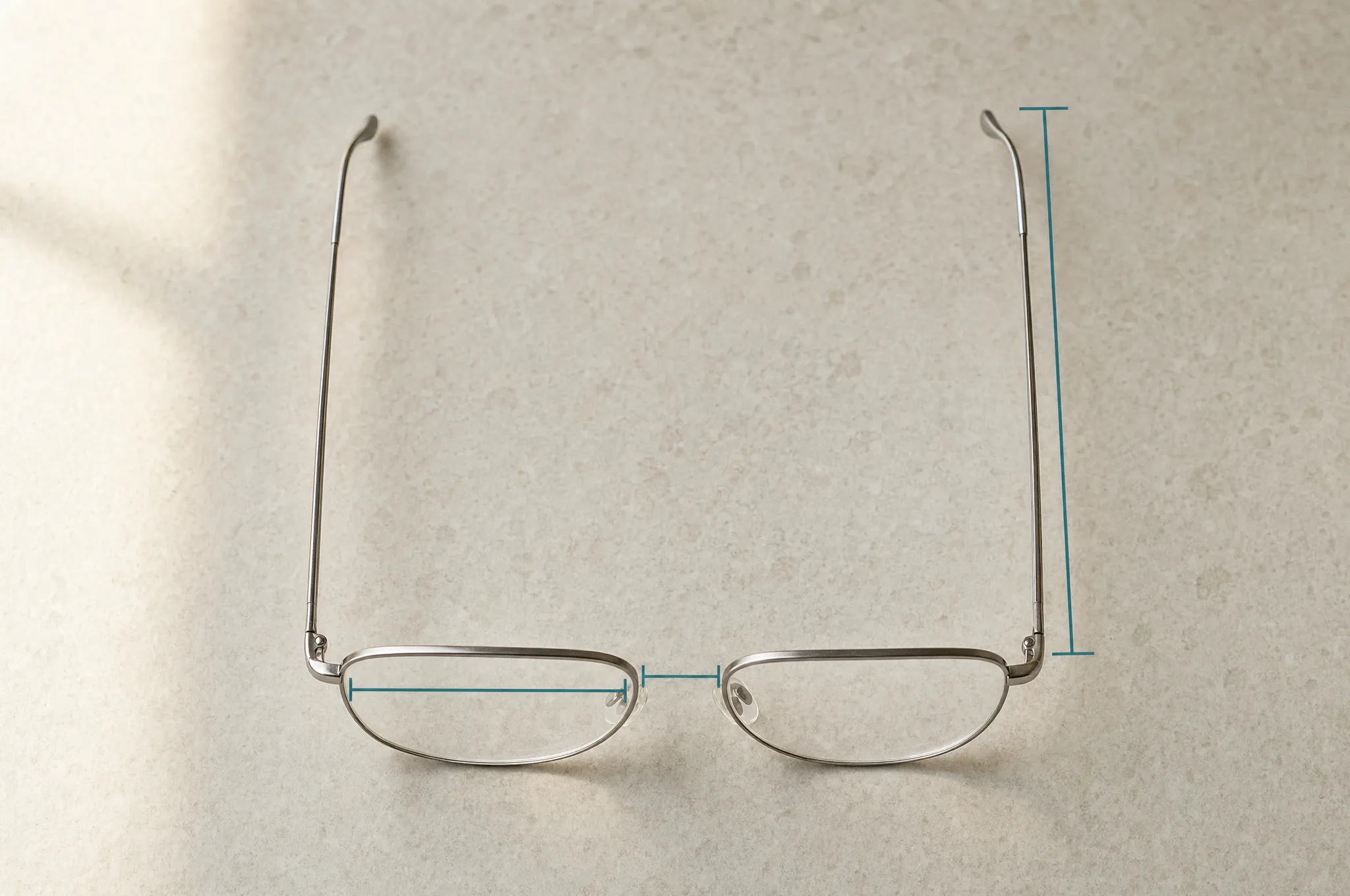
Look inside one of the temple arms of a pair you already own. Somewhere along it there is a string of numbers, usually three, often with a tiny square between the first two: something like 52 □ 18 140. Every one of them is in millimeters.
| Number | What it measures | Typical range |
|---|---|---|
| First (lens width, or “eye size”) | The horizontal width of one lens, not counting the frame around it | 40–60 mm |
| Second (bridge width) | The gap between the two lenses, where the frame sits on your nose | 14–24 mm |
| Third (temple length) | One arm, from the hinge to the tip behind your ear | 120–150 mm |
(Ranges from Warby Parker’s frame measurement guide.)
Temple lengths cluster on round numbers — 135, 140, 145 and 150 are the common sizes. Other letters and numbers on the same arm are the model, color or maker, not measurements.
The first two numbers are defined by the “boxing system”, the convention behind ISO 8624, the international standard for measuring spectacle frames. Each lens is imagined inside the smallest rectangle that contains it; lens width is the width of that box, and bridge width is the gap between the two boxes. That is why lens width is measured at the widest point, and why a rounder lens can carry the same number as a squarer one.
Two more measurements are not usually printed but matter for fit:
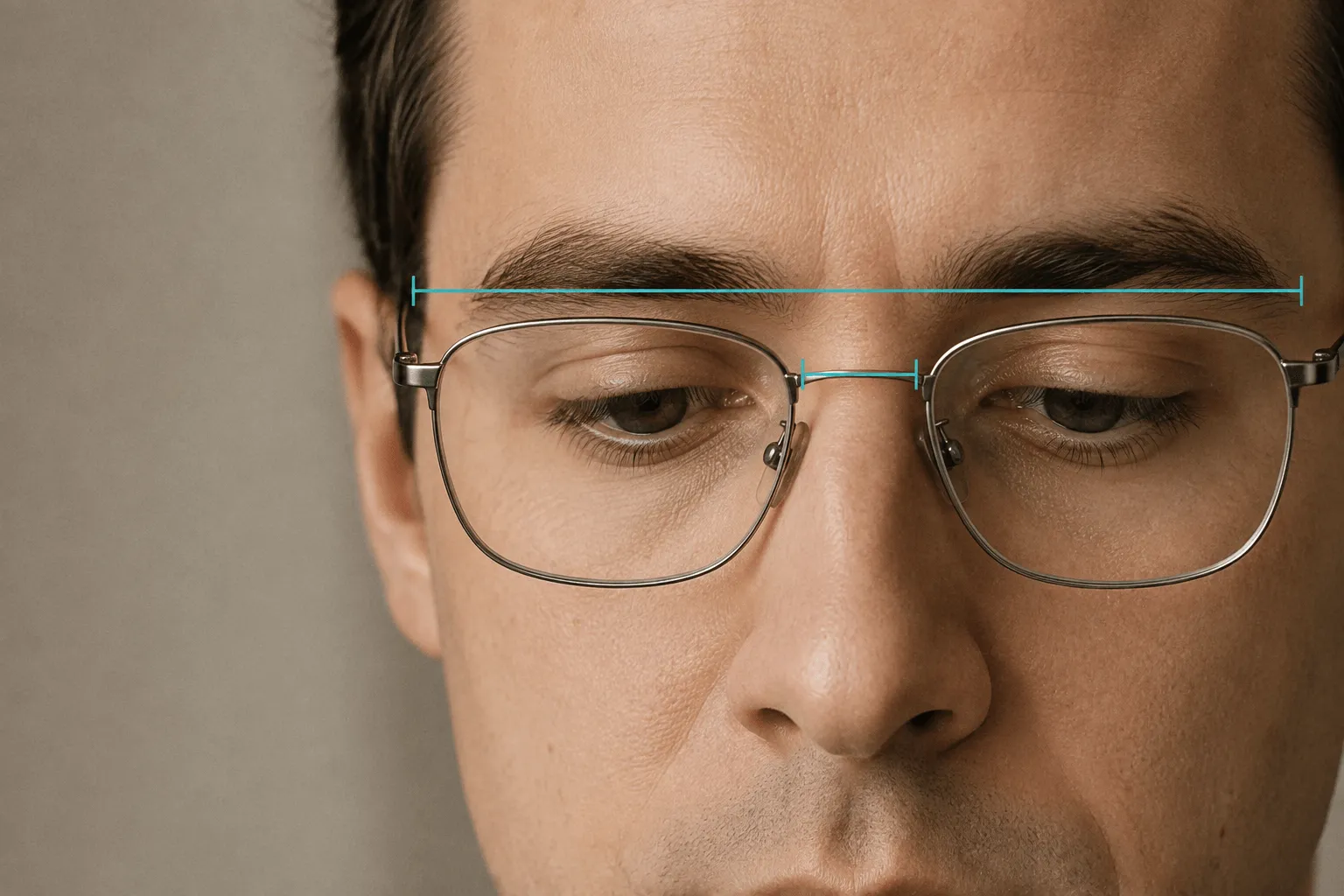
- Frame width — the whole front, end piece to end piece, typically 125–150 mm. This is the number that decides whether the frame looks and feels the right size for your face.
- Lens height — the vertical height of one lens, typically 32–38 mm. It only becomes important for progressive and other multifocal lenses, which need vertical room for their zones.
How do you measure your face for glasses?
You do not measure your face so much as measure a pair of glasses that fits it. Four ways, best first.
1. Read a pair that fits. If you own glasses that sit right, the numbers on the arm are your size. This beats any face measurement, because they encode the outcome — a frame that already sits correctly on your nose and ears.
2. Measure a pair that fits. If the numbers have worn off, take them yourself with a millimeter ruler:
- Lens width: across one lens at its widest point, not including any frame.
- Bridge width: between the two lenses at their nearest points.
- Temple length: hinge to the start of the bend, then bend to tip; add the two.
- Frame width: across the front at its widest point. Zenni measures it from the left hinge screw to the right hinge screw, and their frame size help page suggests staying within ±2 mm of it.
3. The credit card sort. No ruler and no old pair? A standard card’s short edge is about 54 mm. Hold the card under one eye with its long edge on the center line of your nose, and see where the short edge lands:
- ends before the outer corner of your eye → look at wider frames
- lands about on the corner → medium
- reaches past the corner → narrower frames
It is a rough sort into small, medium and large, not a measurement, but it is enough to filter a catalog.
4. Measure your face directly. A ruler across the face at temple level, just in front of the ears, gives you a frame-width target. It is less reliable than the other three because the “right” frame width is a judgment about where the end pieces should sit, not a fixed face dimension.
Which measurement matters most?
Frame width, then bridge, then everything else. The simple rule that most guides agree on: the frame should not be much wider than your face, and your eyes should sit roughly centered in the lenses.
Zenni publishes tolerances that are a useful way to think about how much each number can move from a pair you know fits:
| Measurement | How far you can stray | Why |
|---|---|---|
| Frame width | ±2 mm | The number that controls the overall look and whether the arms pinch or gap |
| Lens width | ±2 mm | Mostly style: a 52 wearer fits a 50 for a smaller look or a 54 for a slightly oversized one |
| Bridge, plastic frame | ±1 mm | A fixed bridge cannot be adjusted; it decides where the frame sits on your nose |
| Bridge, adjustable nose pads | ±2 mm | The pads take up the slack |
| Temple length | ±5 mm | Arms can be bent to fit around the ear |
Note the asymmetry. Lens width, the number people fixate on, is the forgiving one, because a few millimeters there just changes how oversized the frame looks. The bridge on a plastic frame is the strict one, because it has no adjustment and it fixes the height of the whole frame on your face.
Where does pupillary distance fit in?
Mostly, it does not. Your pupillary distance is the distance between your pupils; frame size is the size of the frame. The two are measured separately, entered separately when you order, and one does not choose the other. As Warby Parker’s guide puts it, your PD should not affect the size of your glasses — it affects where the optical center of each lens is placed.
That placement is the one point where the two numbers meet, and it is worth understanding.
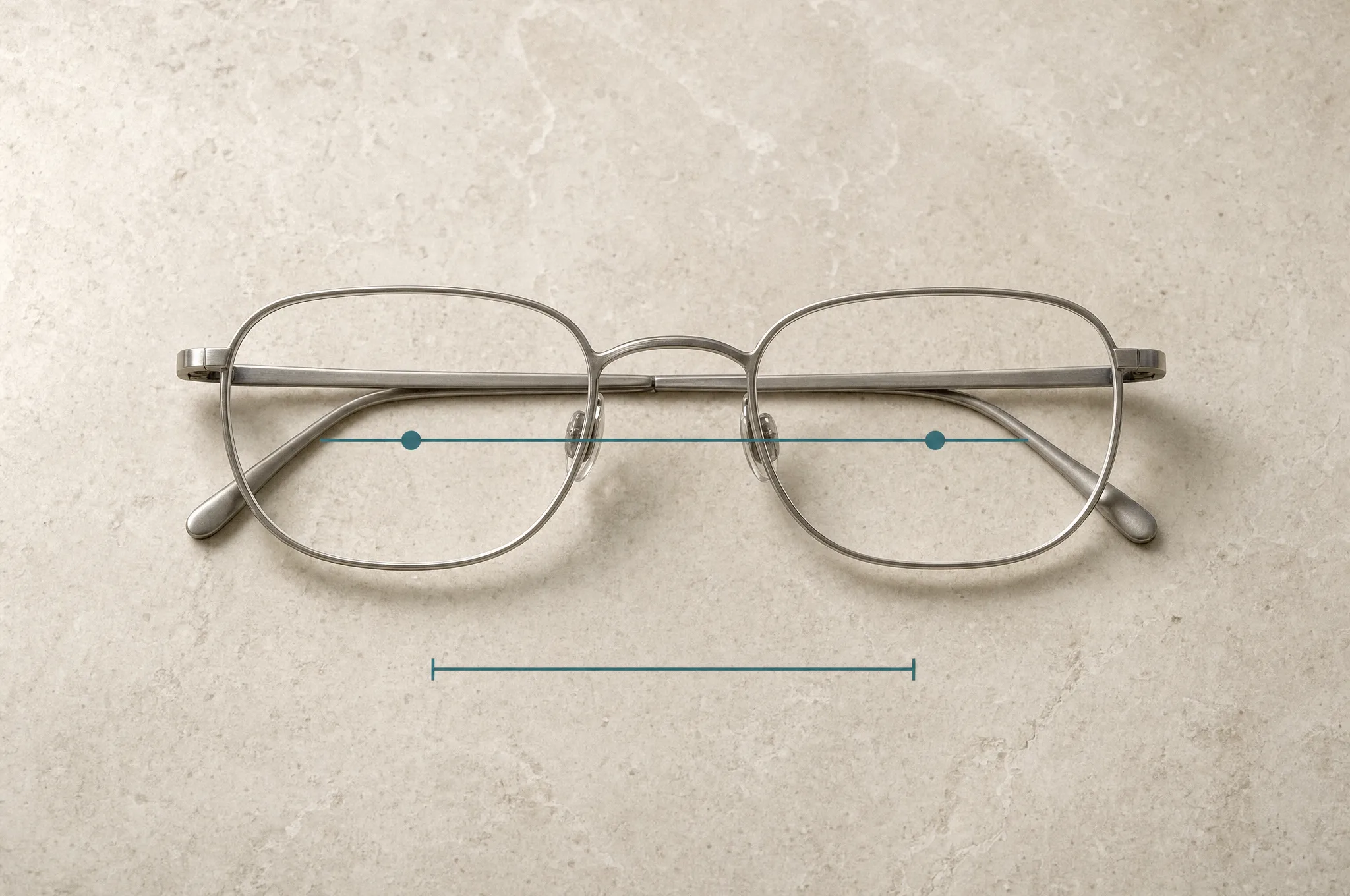
Every frame has its own “PD”: the distance between the geometric centers of its two lenses. Under the boxing system that is simply lens width plus bridge width. A 52 □ 18 frame has a frame PD of 70 mm.
Your own PD is usually smaller than that. When the lab makes your lenses, it moves each optical center inward from the geometric center by half the difference. With a frame PD of 70 and a wearer PD of 64, each lens is decentered 3 mm toward the nose.
Two consequences follow:
- A frame much wider than your PD is asking the lab to shift a lot. It is routinely done, but a big shift on a strong prescription thickens one edge of the lens and stretches what a lens blank can deliver. If your PD is on the narrow side and you like wide frames, that is a conversation to have with an optician before ordering.
- Getting the frame right does not fix a wrong PD. The decentration is only correct if the PD it is based on is. In a study of 120 single-vision wearers, 57% were not looking through the optical centers of their lenses, by about 3.5 mm on average — with symptoms following in 40% of them. That is a centering problem, not a frame-size problem, and our guide to measuring PD at home covers how to avoid it.
Lens height, and why progressives change the rules
For single-vision lenses, lens height is a style choice. For progressives it is a constraint: the distance, intermediate and near zones stack vertically, and the lens needs enough height below your pupil to fit the near zone in. That is why progressive orders carry a fourth measurement, the fitting height, taken with the chosen frame on your face. Very shallow frames force a “short corridor” design with smaller usable zones. We cover all of that in PD for progressive lenses.
What this guide deliberately leaves out
Face shape. Round, oval, heart, square — the styling advice that pairs each with a frame shape is opinion, and there is no measurement behind it, so it does not belong on a page about measurement. Fit is the four numbers above; the rest is taste, and yours is as good as anyone’s.
And the usual boundary: this is about fitting a frame, not about your eyes. If a correctly sized frame with correctly made lenses still gives you headaches or blur, that is a question for an optometrist or ophthalmologist rather than a different pair of frames.
Frequently asked questions
Keep reading
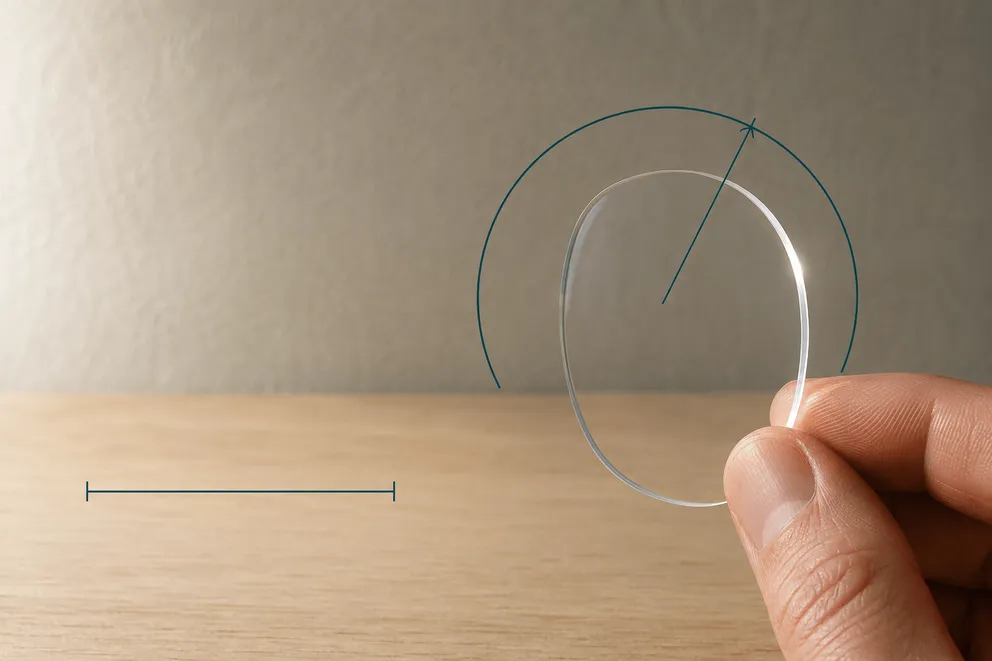
Is Pupillary Distance the Same as Axis?
Is pupillary distance the same as axis? No — PD is in millimeters, axis in degrees. Why the two get confused on a prescription, and what a mix-up does.
Should You Round Your PD Up or Down?
Should you round your PD up or down? What half a millimeter actually costs, from Prentice's rule, and why how you measured matters far more than rounding.
4.4★ · 310+ Reviews
Your PD, measured in under a minute.
Pupillary Distance turns your iPhone into an accurate PD meter. Measure once, then order glasses online with confidence.