What Is Pupillary Distance (PD)?
7 MIN READ
By Pupillary Distance Team · · Updated
Written by the team that builds the app, not by clinicians — how we research and source these guides.
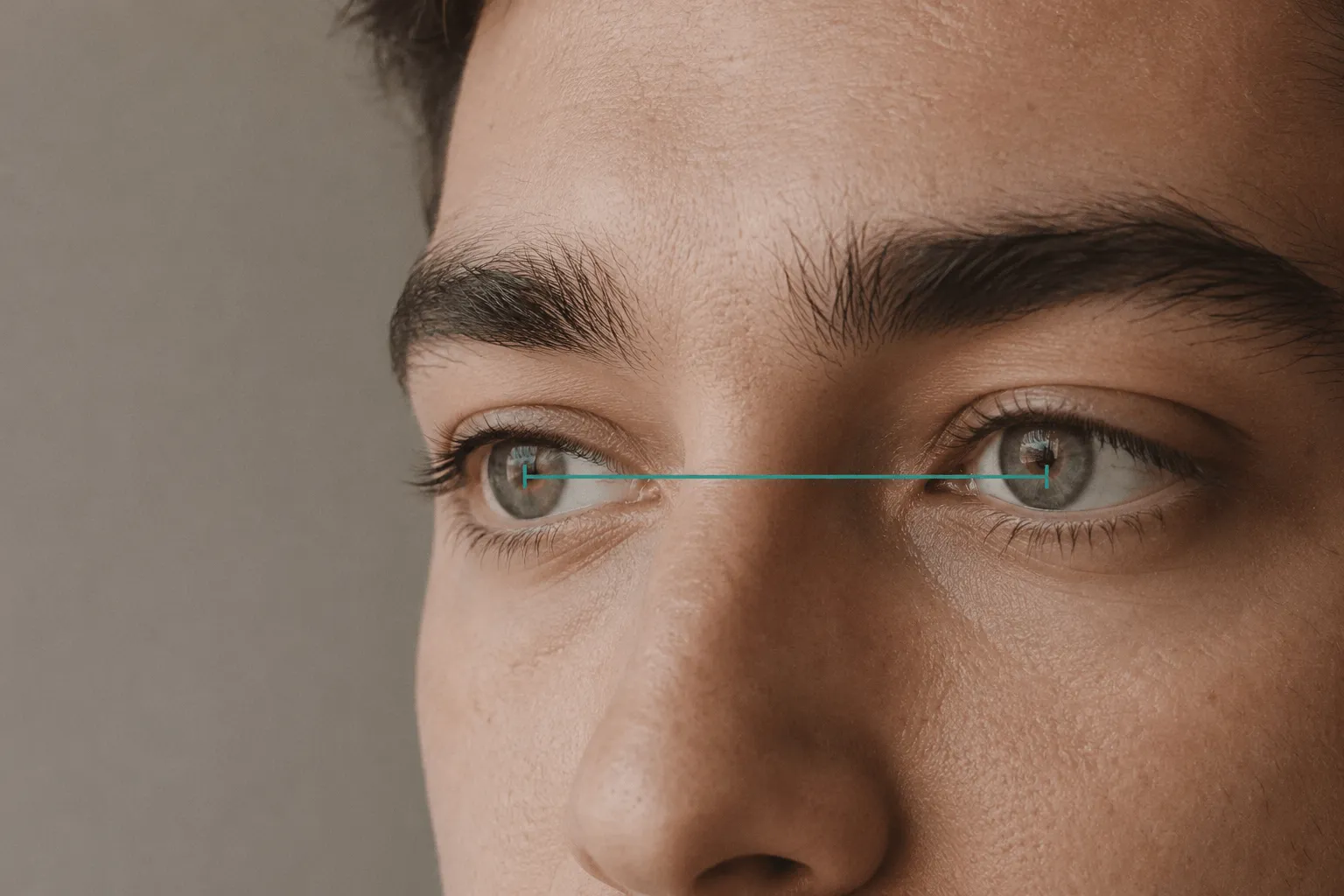
What is pupillary distance?
Pupillary distance is one measurement: the distance between the centers of your two pupils, expressed in millimeters. That is the whole definition. It is a fact about the geometry of your face rather than about your vision, which is why it does not change when your prescription does, and why an optician can measure it without knowing anything about how well you see.
You will see it written as a single number — 63 — or as two, one per eye. Both describe the same face; the difference is where the measurement starts from, which the next sections get to.
Why does your PD exist as a number at all?
Every spectacle lens has an optical center: the one point where light passes straight through without being bent sideways. The lab that makes your glasses positions that point using your PD. Give them the wrong number and the optical center lands off to one side of your pupil, so you look through the lens somewhere other than the spot it was ground for.
That is the entire job of the measurement. It is not a comfort preference or a style choice, and it is not something the frame can absorb — it is a manufacturing input, which is why online retailers ask for it before they will take your order.
Is PD the same as IPD or interocular distance?
PD and IPD mean the same thing. Pupillary distance is what opticians and eyewear retailers say; interpupillary distance is what research papers, anatomy texts and VR headset manuals say. Both mean pupil center to pupil center, both are in millimeters, and you can use whichever the form in front of you asks for.
Interocular distance is the term to be careful with. It is often used loosely as a synonym, but it also gets used for the distance between the eyes’ centers of rotation, which is a different point inside the eye. If a source uses it without defining it, check what it actually measured before you copy a number across.
Far PD, near PD, monocular PD — which is which?
Your eyes converge slightly when you look at something close, so the distance between your pupils is not fixed. That gives three numbers that all get called “PD”, and forms are not always clear about which one they want.
| Number | What it measures | Typical value | Which glasses need it |
|---|---|---|---|
| Far (distance) PD | Pupil to pupil with your eyes relaxed on something far away | The number most people mean by “my PD” | Everyday and distance glasses — the default an online form wants |
| Near PD | The same distance with your eyes converged on something close | About 3 mm smaller than your far PD | Reading glasses, and the near zone of progressives |
| Monocular PD | Bridge of your nose to each pupil, measured separately for left and right | Roughly half your far PD per side, and often not equal | Progressives and strong prescriptions |
The far-to-near gap of about 3 mm is consistent across the literature. One 2021 study of manual and automatic PD measurements reported distance binocular PD roughly 3 mm wider than near PD, with a mean difference of 3.5 mm in women and 3.3 mm in men.
Monocular PD matters because faces are not symmetrical. Your nose bridge is rarely exactly halfway between your pupils, so halving a binocular PD gives each lens a center that is slightly off for at least one eye. On a low-power single-vision lens that is usually invisible. On a progressive, where the corridor between the distance and reading zones is narrow, it is not.
What is a typical pupillary distance?
Most adults fall between 50 mm and 75 mm. The largest published dataset is the US Army’s ANSUR anthropometric survey, analyzed in Dodgson’s 2004 paper on the variation and extrema of interpupillary distance: across 3,976 adults the mean was 63.4 mm with a standard deviation of 3.8 mm, the median and mode were both 63 mm, and recorded values ran from 52 mm to 78 mm. Split by sex, women averaged 62.3 mm and men 64.7 mm.
Two things follow from that, and they matter more than the averages themselves.
First, this is a distribution, not a specification. A PD of 57 mm or 71 mm is uncommon but entirely normal — Dodgson recommends that equipment designers accommodate 45 mm to 80 mm to cover essentially everyone. There is no PD that is too wide or too narrow for glasses.
Second, when a home measurement comes out far from the middle, the measurement is the more likely culprit. Measuring your own PD in a mirror is imprecise enough that a few millimeters of error is ordinary, so an unexpected reading is a reason to measure again rather than a discovery about your face. If you want to check a number against the distribution above, the PD calculator does exactly that, and converts between far, near and per-eye values while it is at it.
Children are a separate case. PD grows as the skull grows, so a child’s number is smaller and changes; a study of 1,311 subjects aged one month to 19 years established normal values and standard deviations across that range. For children’s glasses, measure close to the time you order, and let the dispensing optician do it.
How much does a wrong PD actually matter?
Enough to be worth getting right, and less dramatic than it is often made to sound.
When the optical center sits away from your pupil, the lens induces a small amount of prism. The relationship is Prentice’s rule: the prism, in prism diopters, equals the decentration in centimeters multiplied by the lens power in diopters. So 3.5 mm of decentration on a −4.00 D lens produces about 1.4 prism diopters, while the same 3.5 mm on a −0.50 D lens produces almost nothing.
That “depends on your prescription” is the part most explanations skip. As an ophthalmologist answering for the American Academy of Ophthalmology’s EyeSmart service puts it, progressive lenses in a high plus or minus power can be problematic if the PD is off by a small amount, while low-power single-vision glasses may cause no symptoms even when the PD is off significantly.
The symptoms, when they appear, are unglamorous: eye ache, fatigue, headaches, a vague sense that the glasses are not right. In a study of 120 single-vision spectacle wearers, 57% were not looking through the optical center of their lenses, with a mean decentration of about 3.5 mm, and 40% of those reported exactly that kind of asthenopic discomfort.
What does PD mean on glasses or a prescription?
On a prescription, “PD” is the same measurement this whole page is about, written in one of three ways: a single number such as PD 63 (binocular, far), two numbers such as PD 31.5 / 31 (monocular, right eye then left), or a pair such as PD 63 / 60 (far and near). If the form does not say which, a single number is almost always the far PD. Our guide to where PD appears on a glasses prescription shows the layouts the common forms use and what OD and OS mean next to it.
On the glasses themselves, there is no PD. The three numbers printed inside a temple arm — something like 52-18-140 — are the lens width, bridge width and temple length of the frame in millimeters. They describe the frame, not your eyes, and they cannot be used to work out your PD.
Where do you find your PD, and what if it isn’t there?
Look at your prescription first. If it was written after a dispensing appointment it may carry a “PD” field, sometimes as one number and sometimes as two.
Often it will not be there, and that is not an oversight on anyone’s part. In the United States, the FTC’s Eyeglass Rule requires your prescriber to give you a copy of your prescription after an eye exam — but the pupillary distance is a dispensing measurement rather than part of the refraction, and the rule does not require it to be included. So it routinely is not.
Which leaves measuring it yourself. There are three practical ways to do that: a millimeter ruler and a mirror, a friend with the same ruler, or an iPhone’s TrueDepth front camera reading the distance directly. They differ a lot in how repeatable they are, and our guide to measuring your PD at home walks through all three with the numbers on each. If you would rather not deal with a ruler at all, the Pupillary Distance app returns far PD, near PD and both monocular values in a single measurement.
One thing worth saying plainly: none of this is a substitute for an eye exam. PD is a measurement, not a diagnosis. If your vision has changed, if glasses that should be correct still feel wrong, or if you are buying for a child, see an optometrist or ophthalmologist.
Frequently asked questions
Keep reading
Is Pupillary Distance the Same as Axis?
Is pupillary distance the same as axis? No — PD is in millimeters, axis in degrees. Why the two get confused on a prescription, and what a mix-up does.
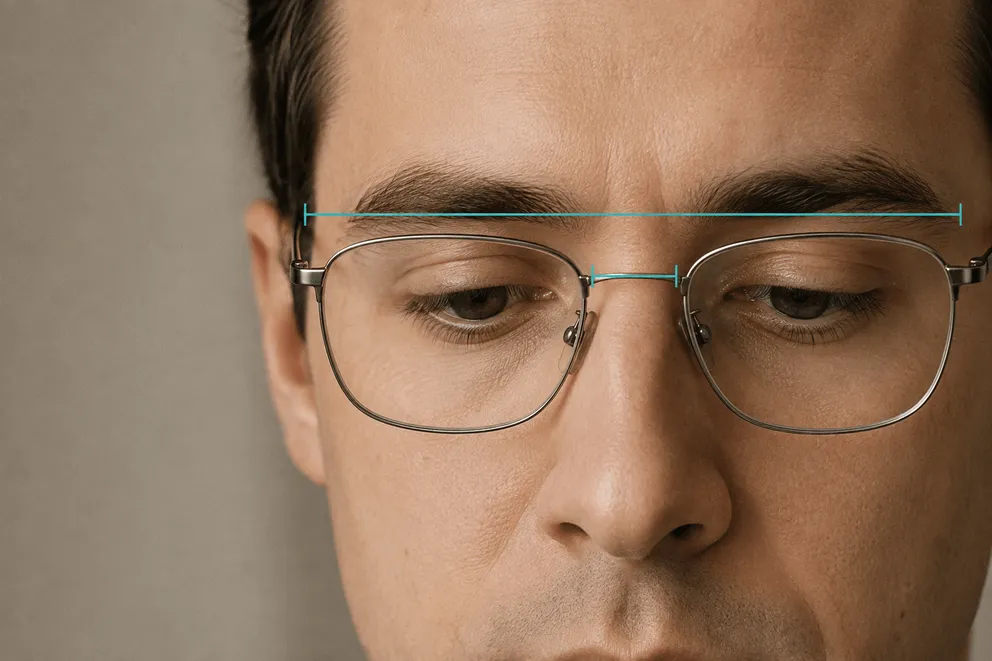
How to Measure Your Face for Glasses (Frame Width, Bridge & Lens Size)
Measure your face for glasses: the three numbers on every frame, taking them from an old pair or your face, which one decides the fit, and where PD fits.
4.4★ · 310+ Reviews
Your PD, measured in under a minute.
Pupillary Distance turns your iPhone into an accurate PD meter. Measure once, then order glasses online with confidence.