Does Your Pupillary Distance Change?
5 MIN READ
By Pupillary Distance Team ·
Written by the team that builds the app, not by clinicians — how we research and source these guides.
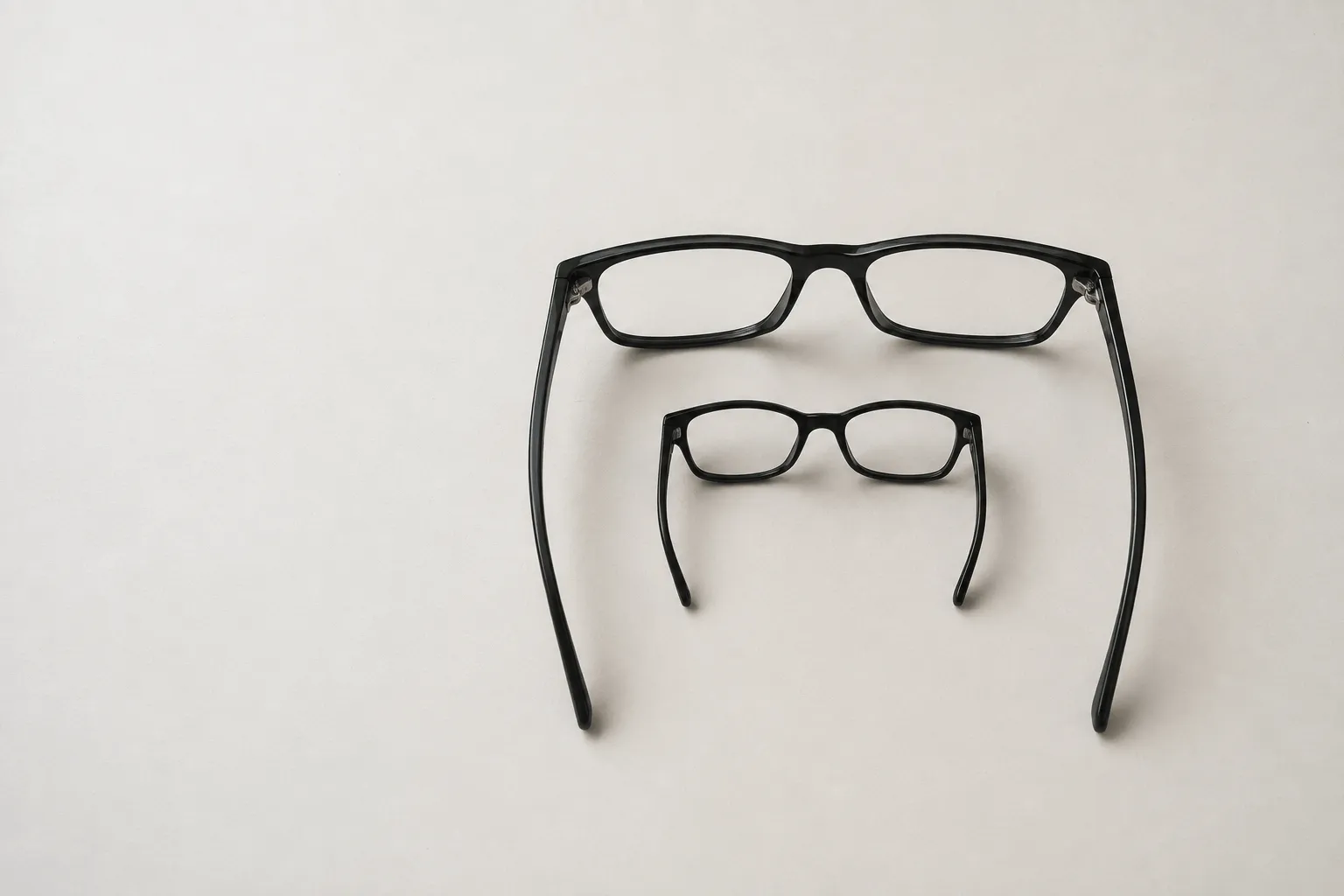
Does pupillary distance change with age?
It grows through childhood and then settles. Your PD is the distance between the centers of your pupils, and that distance is set by the width of your skull and the position of your orbits — so it increases while you are growing and stops when you stop.
The reference work is a study of 1,311 subjects aged one month to 19 years, which established normal values and standard deviations for interpupillary distance across that entire range. The practical consequence for parents is simple: a child’s PD has a shelf life. Measure it close to when you order, and let the dispensing optician take it rather than working from a number written down last year.
For adults, the opposite advice applies. Once you have a PD you trust, keep it. It stays usable across new prescriptions, because it is not describing your vision.
Can your pupillary distance change in adults?
Not in a way that changes what you should type into an eyewear form.
This is the question behind most searches on the topic, and it usually comes from a real experience: someone measured 62 mm last year and 65 mm today, and reasonably concluded that something moved. Almost always, something did — the ruler, not the face.
Adult PD is bone and soft-tissue geometry. It is not maintained by muscle tone, it does not fluctuate with tiredness, and it does not follow your refraction. Ageing changes the lens inside your eye, which is why reading glasses arrive in your forties; it does not move your orbits apart.
The exceptions are the ones you would expect: facial surgery, trauma involving the orbits, or a medical condition affecting facial bone structure. If none of those apply, an adult PD that appears to have changed is a measurement question, not an anatomical one.
So why is my PD different from last time?
Three explanations, in order of how often they turn out to be the answer.
| Explanation | What it looks like | Typical size |
|---|---|---|
| Measurement error | Two home readings of the same face disagree | Several mm — mirror self-measurement repeats to only about 4 mm either way |
| Far versus near PD | The optician’s number and your own differ consistently in one direction | About 3 mm, with near always narrower |
| Binocular versus monocular | One number on one form, two numbers on another | Each per-eye value is roughly half the combined one |
Measurement error comes first because it is the largest. In one study of self-measurement accuracy, people measuring themselves in a mirror repeated to only about 4 mm either way, and individual readings differed from a clinical pupillometer by as much as 5 to 6 mm in either direction. A trained examiner with a PD rule repeated to within about 1 mm. So a 3 mm difference between two of your own measurements is well inside the noise of the method — it is not evidence of anything.
Far versus near is the one real change, and it is covered below.
Binocular versus monocular catches people out when they switch retailers. A binocular PD of 63 and monocular values of 32 and 31 describe the same face; one form wanted one number and the other wanted two.
Does your PD change when you look at something close?
Yes, and this is the genuine variation in adults.
Your eyes rotate inward — converge — to focus on something near, which brings your pupils closer together. So the same face has two legitimate numbers: far PD, measured with your eyes relaxed on something distant, and near PD, measured with them converged on something close.
The gap is consistently around 3 mm. A 2021 study of manual and automatic PD measurements found distance binocular PD roughly 3 mm wider than near PD, with a mean difference of 3.5 mm in women and 3.3 mm in men.
This matters more than it sounds, because it quietly explains a common complaint. If you measured yourself in a mirror and got a number a few millimeters below what an optician later recorded, that is expected rather than an error: your reflection sits about twice the mirror distance away, close to the convergence distance near PD is defined at, so a mirror reading behaves like a near PD. Our guide to measuring PD at home goes through that in detail.
Everyday distance glasses use far PD. Reading glasses use near PD. Progressives use both, along with per-eye values — which is why the Pupillary Distance app returns far, near and both monocular numbers in one measurement rather than making you convert between them.
How often should you re-measure?
For an adult, once — properly — and then keep the number.
Re-measure if any of these apply:
- You have had facial surgery or an injury involving the orbital area.
- You are ordering progressives or a strong prescription and only have a single binocular number, where per-eye values are what the lab wants.
- You are not confident the original measurement was taken carefully, which for a first home attempt is a reasonable suspicion.
- You are measuring for a child, in which case measure close to the order date, every time.
If you want to check whether a new reading is plausible before trusting it, the PD calculator places it against the published adult distribution and converts between far, near and per-eye values.
One closing caveat, as with anything on this site: PD is a measurement, not a diagnosis. If your vision has changed, if glasses that should be correct still feel wrong, or if you are dealing with anything that has actually altered your facial structure, see an optometrist or ophthalmologist rather than working from a number you took at home.
Frequently asked questions
Keep reading
Is Pupillary Distance the Same as Axis?
Is pupillary distance the same as axis? No — PD is in millimeters, axis in degrees. Why the two get confused on a prescription, and what a mix-up does.
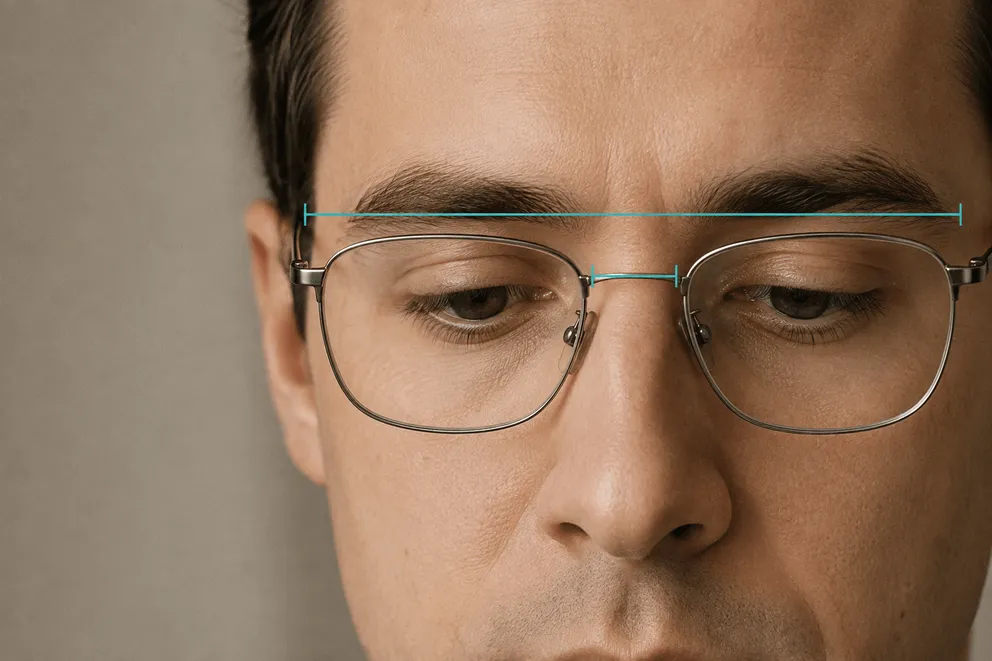
How to Measure Your Face for Glasses (Frame Width, Bridge & Lens Size)
Measure your face for glasses: the three numbers on every frame, taking them from an old pair or your face, which one decides the fit, and where PD fits.
4.4★ · 310+ Reviews
Your PD, measured in under a minute.
Pupillary Distance turns your iPhone into an accurate PD meter. Measure once, then order glasses online with confidence.