Does PD Matter? What a Wrong Pupillary Distance Does
4 MIN READ
By Pupillary Distance Team ·
Written by the team that builds the app, not by clinicians — how we research and source these guides.
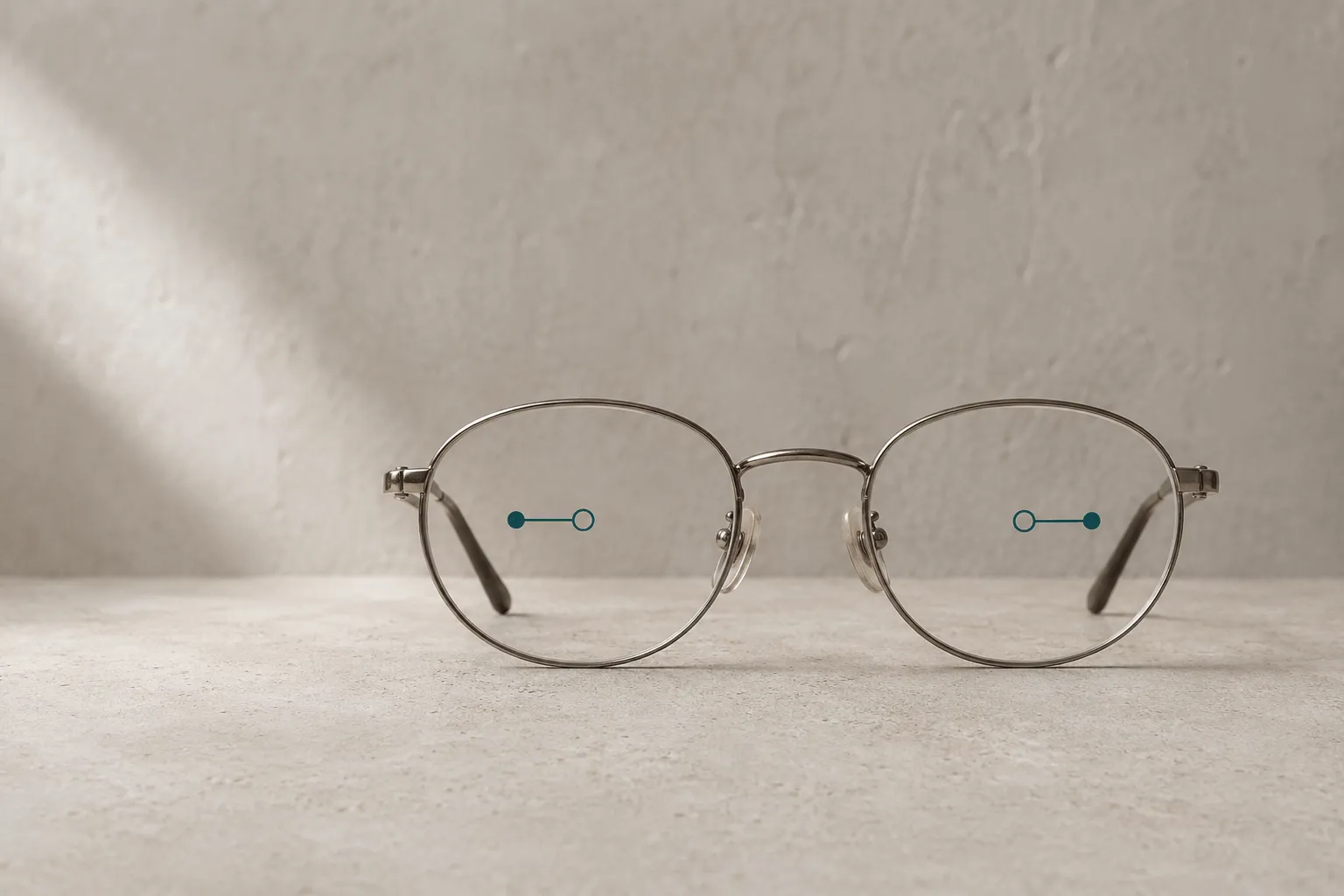
Does pupillary distance actually matter?
Yes — with a conditional that most pages skip.
Every lens has an optical center, the one point where light passes through without being bent sideways. Your PD tells the lab where to put it. Get it wrong and you look through the lens somewhere other than that point, which introduces a small prism into your vision.
The conditional is that prism scales with lens power. A few millimeters of error in a weak prescription produces an amount of prism you will never notice. The same error in a strong prescription produces several times more. So “does PD matter” has no single answer — it has an answer that depends on the glasses you are ordering.
What happens if your PD is wrong?
You get prism you did not ask for, and it is not hypothetical: it is common.
In a study of 120 single-vision spectacle wearers, 57% were not looking through the optical center of their lenses, with a mean decentration of about 3.5 mm. The induced prism across that group ran from −0.7 to +0.6 prism diopters, and 40% of those with a misaligned optical center reported asthenopic symptoms — eye ache, fatigue, discomfort.
The mechanism has a name and a formula. Prentice’s rule: the induced prism, in prism diopters, equals the decentration in centimeters multiplied by the lens power in diopters. The unit trap is worth flagging, because a PD error is naturally measured in millimeters and the rule wants centimeters — 3.5 mm is 0.35 cm.
How far off does it have to be before you notice?
Far enough that the arithmetic is worth doing rather than guessing. Applying Prentice’s rule to a 3 mm error:
| Lens power | Prism from 3 mm of decentration |
|---|---|
| −1.00 D | 0.3 prism diopters |
| −2.00 D | 0.6 |
| −4.00 D | 1.2 |
| −6.00 D | 1.8 |
| −8.00 D | 2.4 |
(Computed from Prentice’s rule — 0.3 cm × lens power. The same arithmetic applies to plus lenses.)
For scale on those numbers: the 2024 comparison of PD measurement techniques judged its results against a tolerance of 0.33 prism diopters for horizontally induced prism, from ISO 16034 — and found every method it tested, including the ruler ones, stayed inside it.
Read the table alongside that and the picture is clear. At −1.00 D you have room to be a few millimeters out. At −6.00 D the same error puts you well past the tolerance a manufacturing standard uses. This is why the honest answer to “how accurate does my PD need to be” starts with “how strong are your glasses”.
What do the symptoms feel like?
Rarely dramatic, which is exactly why a wrong PD goes undiagnosed.
The published descriptions are of eye strain, discomfort and headaches, along with blurred or distorted vision when the optical center is misplaced. The study above found eye ache and fatigue in 40% of the people whose lenses were decentered.
What that means in practice: new glasses that feel subtly wrong — tiring to wear, a bit off, fine for ten minutes and unpleasant after an hour — are worth checking against your PD before you conclude the prescription is wrong. It is a cheaper thing to rule out.
Does it matter more for progressives and strong prescriptions?
Yes, on both counts, and the clearest statement of it comes from an ophthalmologist answering for the American Academy of Ophthalmology’s EyeSmart service: progressive lenses in a high plus or minus power can be problematic if the PD is off by a small amount, while low-power single-vision glasses may cause no symptoms even when the PD is off significantly.
Progressives add a second reason beyond raw power. Their distance, intermediate and reading zones sit in a narrow corridor down each lens, so the lens has to be centered horizontally on the eye that is actually looking through it. That means per-eye monocular PDs rather than one binocular number — halving a single figure assumes a symmetrical face, and most faces are not.
If you are ordering progressives or anything above a few diopters, this is the case for not estimating. Our guide to measuring your PD at home covers the methods and their real accuracy, and the Pupillary Distance app returns far, near and both monocular values in one measurement, which is the format those lenses need.
So how accurate does your PD need to be?
To the nearest millimeter, taken carefully, and more carefully the stronger your prescription.
The practical constraint is not the last half millimeter — it is that home measurement is imprecise. Measuring yourself in a mirror repeats to only about 4 mm either way, against roughly 1 mm for a trained examiner with a PD rule. So the useful discipline is to take three readings and average them, rather than to agonize over rounding. If you want to sanity-check a number against the published adult distribution, or convert it into near and per-eye values, the PD calculator does both.
And the boundary worth stating plainly: this page is about a measurement, not about your eyes. If glasses still feel wrong after the PD checks out, that is a conversation for an optometrist or ophthalmologist rather than another round of measuring.
Frequently asked questions
Keep reading
Is Pupillary Distance the Same as Axis?
Is pupillary distance the same as axis? No — PD is in millimeters, axis in degrees. Why the two get confused on a prescription, and what a mix-up does.
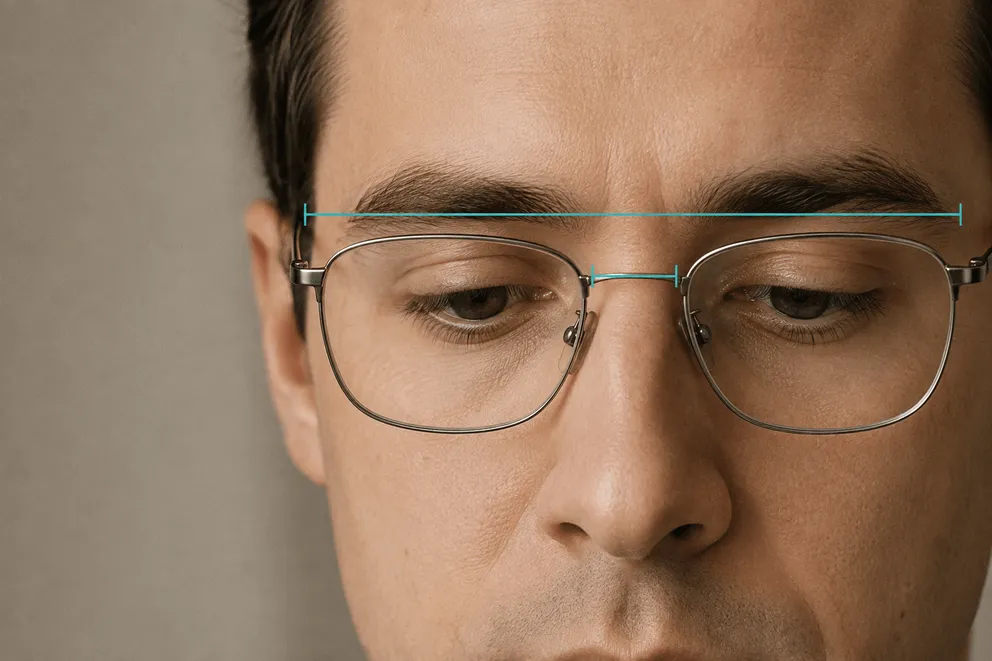
How to Measure Your Face for Glasses (Frame Width, Bridge & Lens Size)
Measure your face for glasses: the three numbers on every frame, taking them from an old pair or your face, which one decides the fit, and where PD fits.
4.4★ · 310+ Reviews
Your PD, measured in under a minute.
Pupillary Distance turns your iPhone into an accurate PD meter. Measure once, then order glasses online with confidence.