Pupillary Distance for Kids: Average PD by Age
4 MIN READ
By Pupillary Distance Team ·
Written by the team that builds the app, not by clinicians — how we research and source these guides.
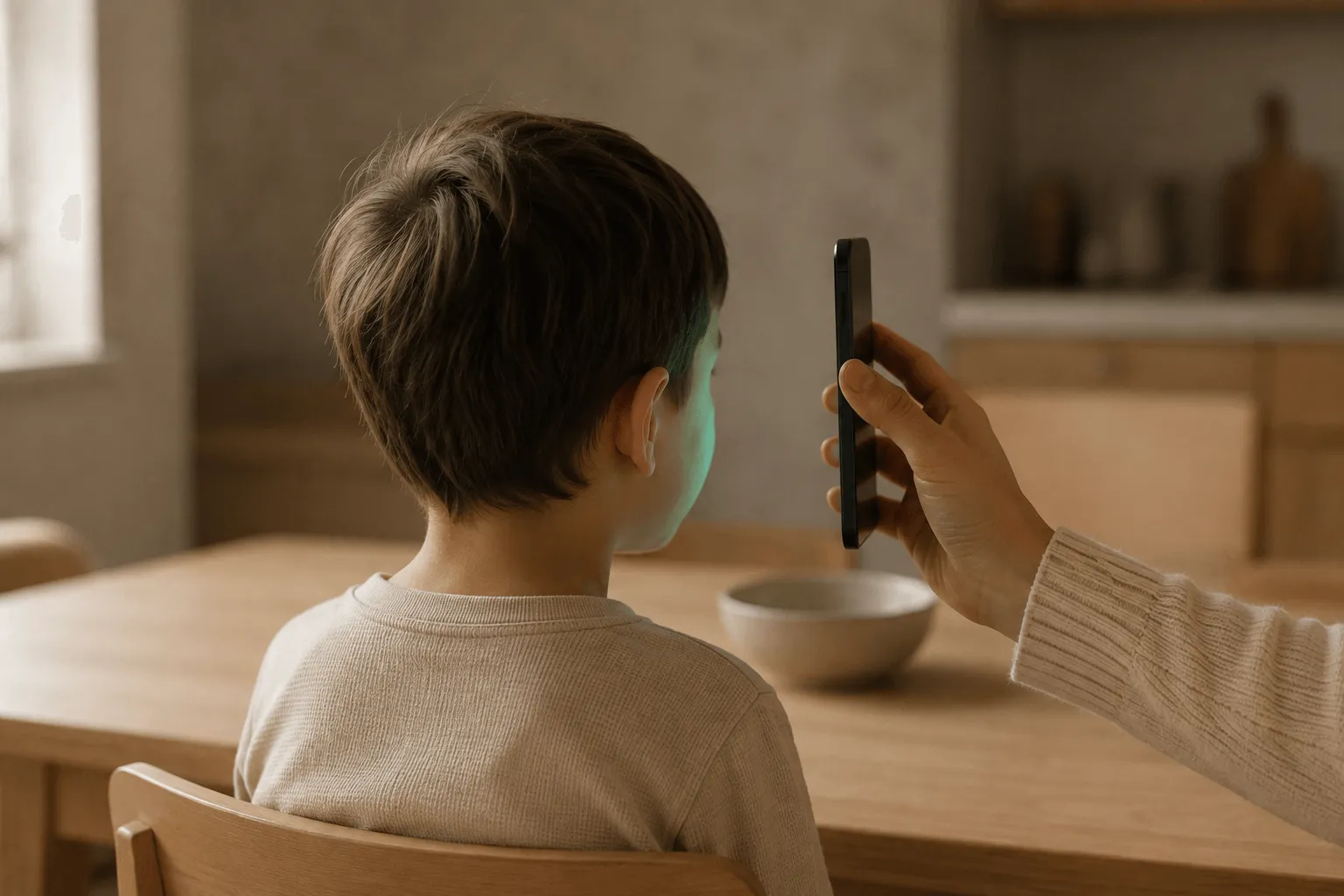
Average pupillary distance by age
The reference work here is a study of 1,311 subjects aged one month to 19 years, across 4,294 visits, which measured interpupillary distance and published growth equations for it by age and sex.
Evaluating those published equations gives the following averages. These are calculated from the authors’ own model, not sampled from a table:
| Age | Boys | Girls |
|---|---|---|
| 1 | 45.0 mm | 43.6 mm |
| 2 | 46.5 mm | 45.3 mm |
| 4 | 49.5 mm | 48.5 mm |
| 6 | 52.1 mm | 51.2 mm |
| 8 | 54.5 mm | 53.6 mm |
| 10 | 56.6 mm | 55.5 mm |
| 12 | 58.4 mm | 57.0 mm |
| 14 | 60.0 mm | 58.0 mm |
| 16 | 61.3 mm | 58.7 mm |
| 18 | 62.3 mm | 59.0 mm |
Two things to read out of that table before using it.
The growth is front-loaded. Between ages 1 and 6 the average gains about 7 mm — well over a millimeter a year. Between 14 and 18 it gains about 2 mm in total. That is why a toddler’s measurement goes stale quickly and a teenager’s does not.
The sex difference is small. Across the whole study population, boys averaged about 1.6 mm wider than girls. In early childhood that is less than a single year of growth, and it is smaller than the error most people make measuring at home. It is a sanity check, not a shortcut.
Why a child’s PD has a shelf life
Pupillary distance is set by the width of the skull and the position of the orbits. In an adult those are fixed, which is why an adult PD does not meaningfully change and stays usable across new prescriptions for years.
In a child they are still growing. A measurement taken at one appointment can be a millimeter or two out by the next, and the younger the child the faster it moves. So the rule is different: an adult measures once, carefully; for a child you measure every time you order.
The consequence of using a stale number is the same as any PD error — each lens sits off-center, inducing prism in proportion to the lens power. It matters more in a stronger prescription, and children’s prescriptions are not always weak.
How should a child’s PD be measured?
Let the dispensing optician do it, if you have the option. It takes seconds with a pupillometer and sidesteps the two things that make home measurement genuinely hard with children: staying still, and looking at the right distance for long enough. A pupillometer is also the reference method — home measurement in a mirror repeats to only about 4 mm either way even for a cooperative adult.
If you are measuring yourself, two adjustments to the usual advice:
- Have someone else hold the ruler. The mirror method needs the person being measured to close one eye at a time and hold still while reading a scale — a lot to ask of a young child. A second adult measuring across the bridge of the nose is easier and steadier.
- Watch what they are looking at. PD depends on viewing distance: eyes converge on something close, giving a narrower number. If a child is watching your face rather than something across the room, you have measured closer to their near PD than their far PD, and it will read a couple of millimeters low.
Our guide to measuring PD at home covers the methods and what each is actually worth, and the PD calculator will convert a reading between far, near and per-eye values.
Why the table stops short of adult averages
Worth flagging, because it looks like an inconsistency. At age 18 the equations give about 62 mm for boys and 59 mm for girls, while the adult averages from the ANSUR anthropometric survey are 64.7 mm and 62.3 mm.
That gap is not a contradiction so much as a limit of the model. The equations were fitted to data ending at 19 years, and a curve fitted to a range tends to flatten at its edge; the two studies also measured different populations with different methods, decades apart. So treat the upper end of the table as approximate, and for anyone in their late teens use the adult figures as the better reference.
The boundary worth naming
Everything above is about a measurement, not about a child’s eyes. PD tells the lab where to put the optical centers; it says nothing about whether the prescription is right or whether vision is developing normally.
Children’s vision needs professional attention on its own schedule. If a child squints, tilts their head, sits very close to screens, or complains of headaches, that is a reason to see an optometrist or ophthalmologist — regardless of what any measurement at home says.
Frequently asked questions
Keep reading
Can I Use My Phone to Measure My Pupillary Distance?
Yes, for most adults: in studies, the better phone PD apps came within about 0.5 mm of clinic readings. Which phones work, selfie tools, and when to see an optician.
Is Pupillary Distance the Same as Axis?
Is pupillary distance the same as axis? No — PD is in millimeters, axis in degrees. Why the two get confused on a prescription, and what a mix-up does.
4.4★ · 310+ Reviews
Your PD, measured in under a minute.
Pupillary Distance turns your iPhone into an accurate PD meter. Measure once, then order glasses online with confidence.